Installing a fence along an established property line can sometimes mean digging in places where trees have been growing for decades.
And that’s when things get complicated.
Tree roots don’t necessarily stay neatly underneath the tree’s canopy. They can extend a considerable distance from the trunk, and a fence line can easily run right through them. So what happens when fence posts have to be installed where there are roots in the way?
The answer depends on the tree.
Some trees tolerate a surprising amount of root disturbance. Others are much more sensitive. The size and age of the tree also matter, as does how much of its root system is affected.
Not All Tree Roots Are the Same
One common misconception is that a tree has a single large root system directly underneath it that anchors it in place.
In reality, much of a tree’s absorbing root system is relatively shallow and spreads outward from the trunk. These smaller roots are responsible for taking up water and nutrients.
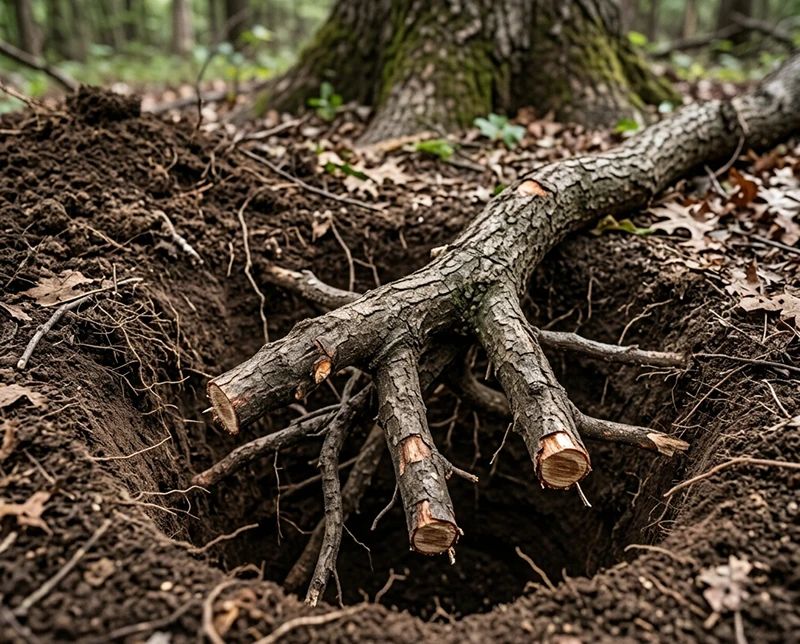
The large structural roots closer to the trunk are a different matter. Cutting one of these can have much more serious consequences than removing a few smaller roots farther away.
That’s why digging a fence post beside a mature tree isn’t automatically a problem—but cutting through substantial roots close to the trunk can be.
Some Trees Handle Root Disturbance Better Than Others
Tree species vary considerably in their ability to tolerate root damage.
Maples, for example, can generally tolerate some root disturbance, particularly when the damage is limited to smaller roots away from the trunk. Silver maple and Manitoba maple are also commonly encountered along older residential property lines and can be quite resilient.
Ash and poplar can also tolerate a certain amount of root disturbance. These are vigorous trees with extensive root systems, although that doesn’t mean their major roots should be casually cut.
Other species can be considerably less forgiving.
Birch trees can be sensitive to root disturbance, particularly mature specimens. Beech can also be vulnerable to damage because of its relatively shallow root system.
Oak trees deserve particular care. A mature oak may have substantial structural roots extending well beyond the trunk, and damaging major roots can affect the tree’s stability as well as its long-term health.
Young Trees vs. Mature Trees
The age and size of the tree can be just as important as the species.
A young, healthy tree has had less time to develop an extensive root system. It also generally has greater capacity to compensate for the loss of a small number of roots.
A mature tree is a different story.
A large established tree may have invested decades developing its root system. Cutting a major root close to the trunk can cause significant stress, and in some cases the consequences may not become apparent immediately.
This is one reason we pay particular attention to large established trees when planning a fence installation.
How Much Root Damage Is Too Much?
There isn’t a simple rule such as “one root is fine, two roots are bad.”
The location and size of the root matter.
Cutting a few small feeder roots several metres from the trunk is very different from cutting a large structural root immediately beside the trunk.
The condition of the tree matters too. A healthy, vigorous tree that loses a small amount of its root system may recover without any obvious problem. A tree that is already stressed by drought, disease, construction damage or poor growing conditions may have considerably less capacity to cope.
More Questions?
If you have questions about root systems or how we handle them while installing a fence, give us a call at (613) 736-1122. We’d love to hear from you!