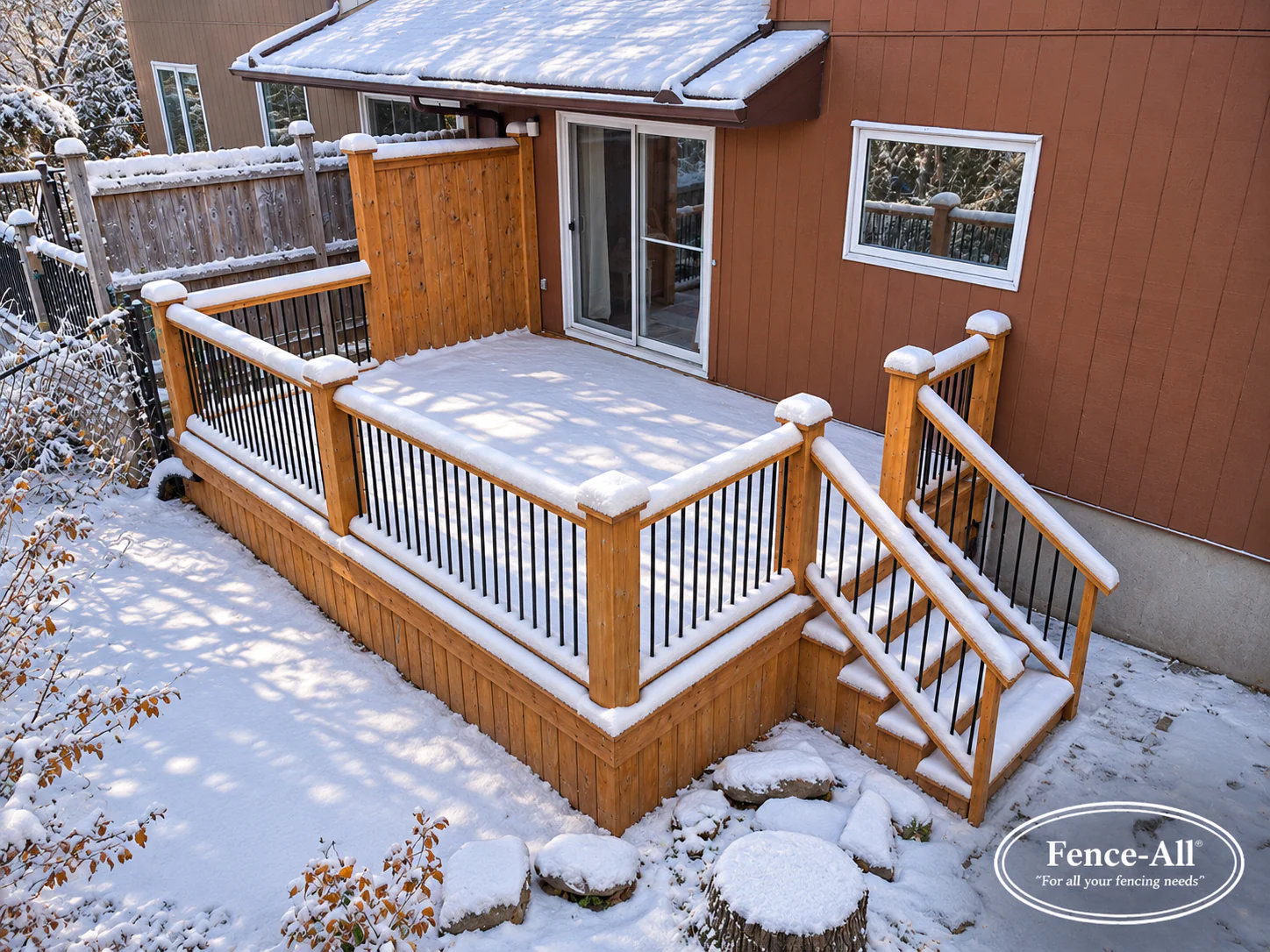
Composite vs Wood Decking: Which Lasts Longer in Canadian Winters?
If you’re comparing a composite vs wood deck for a Canadian home, longevity is probably near the top of your list. Snow, ice, moisture, freeze-thaw cycles, and major temperature swings can put any outdoor material to the test.
The short answer: quality composite decking generally requires less maintenance to resist moisture-related deterioration than untreated or poorly maintained wood, while a properly built and maintained wood deck can also provide many years of service. The better choice depends on your budget, preferred appearance, and how much ongoing maintenance you’re prepared to do.
There’s another option worth knowing about, too. Fence-All offers Cellular PVC decking, a low-maintenance synthetic decking material that’s different from wood-plastic composite. We’ll explain that distinction below.
Composite vs Wood Deck: Quick Comparison
If you’re weighing the two options, the biggest differences come down to maintenance, appearance, upfront investment, and long-term performance.
- Appearance: Wood offers natural grain and character, while composite decking is manufactured in a range of consistent finishes.
- Maintenance: Wood requires periodic maintenance to protect its appearance and condition. Composite generally requires less ongoing upkeep.
- Moisture resistance: Wood needs appropriate protection and maintenance, while quality composite products are designed to resist moisture-related deterioration.
- Winter upkeep: Wood may require staining or sealing over its lifetime. Many composite products don’t require either.
- Upfront cost: Wood typically has a lower initial material cost, while composite generally requires a higher upfront investment.
- Long-term ownership: Wood trades a lower initial cost for more ongoing maintenance, while composite can reduce maintenance demands over time.
Composite vs. Cellular PVC: An Important Difference
Before comparing composite and wood decking, it’s important to clarify what we mean by “composite.”
Composite decking is made by combining wood fibres or wood flour with plastic. Our low-maintenance alternative to traditional wood decking is Cellular PVC, which contains no wood fibre.
That distinction matters, particularly in a climate like Ottawa and Gatineau’s.
The plastic in composite decking helps protect it from moisture, and modern capped composite products add an exterior polymer layer for additional protection. However, the core still contains wood fibres. If moisture reaches those fibres, they can absorb water and swell, and prolonged moisture exposure can contribute to deterioration in susceptible wood-plastic composites.
Cellular PVC removes the wood component entirely. That gives it several practical advantages over traditional wood-plastic composite decking:
- Greater moisture resistance. With no wood fibres in the board, Cellular PVC doesn’t have the same wood component that can absorb moisture and swell.
- No wood-fibre rot. Because the decking itself contains no wood, there is no wood fibre within the board to decay from moisture exposure.
- Lighter weight. Cellular PVC is generally lighter than wood-plastic composite decking, making it easier to handle during installation.
- Low maintenance. Our Cellular PVC decking doesn’t require the staining or painting associated with traditional wood decking.
Research into wood-plastic composites confirms that the wood component is important to moisture behaviour: as wood content increases, water absorption can increase because the wood particles themselves are able to absorb water.
How Canadian Winters Affect Your Deck
Ottawa and Gatineau decks experience much more than snowfall.
Moisture can enter vulnerable materials during wet conditions, followed by freezing temperatures that put additional stress on outdoor surfaces. Decks also encounter ice, snow accumulation, spring thaw, summer heat, and year-round UV exposure.
That’s why winter performance isn’t simply about whether a board can survive cold temperatures. The deck needs appropriate materials, sound construction, drainage, and ongoing care.
The National Research Council of Canada’s Canadian Construction Materials Centre evaluates certain composite decking products for use in Canadian construction. Its testing can include properties such as dimensional change, accelerated aging, weathering, strength, and performance following wetting, freezing, thawing, and drying cycles.
How Does Wood Decking Handle Winter?
Wood remains a popular deck material for good reason. Its natural grain and warmth are difficult to reproduce, and it can complement everything from traditional homes to contemporary backyards.
The trade-off is maintenance.
Because wood is a natural material, exposure to moisture and changing weather can affect it over time. Cleaning, staining or sealing when appropriate, inspecting boards and fasteners, and addressing damage before it spreads all contribute to the deck’s longevity.
That doesn’t make wood a poor choice for Canadian winters. It simply means homeowners need to be comfortable maintaining it.
For someone who loves the appearance of real wood and doesn’t mind periodic upkeep, a professionally built wood deck can still be an excellent choice.
How Does Composite Decking Handle Winter?
Composite decking typically combines wood fibres with plastic or other synthetic components, although the exact construction varies considerably between manufacturers.
Its main advantage in this comparison is reduced maintenance. Many composite products don’t require the regular staining or sealing associated with wood, and products designed for exterior use are engineered with weather exposure in mind.
That doesn’t mean every composite board performs identically. Product quality, construction, installation requirements, warranties, and approved uses vary.
If you’re considering composite decking, look beyond the word “composite” and evaluate the specific product. The National Research Council maintains assessments for a range of composite decking products that have been evaluated against Canadian code requirements.
Which Decking Material Lasts Longer?
If the comparison is based purely on resistance to moisture-related deterioration and maintenance requirements, quality synthetic decking generally has the advantage over wood.
But longevity isn’t determined by the deck boards alone.
The structure underneath them matters. So do installation quality, drainage, footings, fasteners, ventilation, maintenance, and how quickly damage is addressed.
A premium deck board installed on a poorly planned structure isn’t automatically a long-lasting deck.
This is also why choosing between wood and a low-maintenance alternative shouldn’t come down to lifespan alone. Consider how long you expect to own the home, how much maintenance you’re willing to perform, the appearance you prefer, and your initial budget.
Does Low-Maintenance Decking Cost More?
Generally, homeowners should expect a higher upfront material investment for premium low-maintenance decking than for many traditional wood options.
The trade-off is what happens after installation.
Wood may cost less initially but requires ongoing maintenance over its lifetime. Cellular PVC eliminates staining and painting of the deck boards, which can reduce both the work and recurring maintenance expenses associated with keeping a wood surface protected.
Rather than comparing installation prices alone, think about lifetime ownership: upfront cost, maintenance, time, appearance, and expected use.
Does the Foundation Matter in Winter?
Absolutely.
The decking surface is only one part of the structure. Ottawa’s freeze-thaw conditions make proper support and construction particularly important.
If you’ve encountered deck blocks while researching your project, our guide to what a deck block is and how it works explains where this type of foundation fits into deck construction.
Local building requirements matter as well. In Ottawa, certain decks require a building permit based on factors including their height, size, location, and relationship to the home. The City also notes that decking other than conventional lumber may require a material testing report as part of a permit submission.
So, Should You Choose Wood or Low-Maintenance Decking?
Choose wood if natural appearance and a lower initial material cost are priorities and you’re comfortable with regular maintenance.
Consider low-maintenance decking if reducing staining, painting, and ongoing upkeep matters more and you’re comfortable with a potentially higher upfront investment.
For Ottawa and Gatineau homeowners considering Fence-All specifically, that means comparing a traditional wood deck with our Cellular PVC decking options rather than assuming all synthetic decking is the same.
Neither choice is universally better. The right deck is the one that fits your home, budget, maintenance expectations, and how you plan to use the space.
Plan Your Deck Before Next Season
Fall and winter are useful times to start researching a deck project. You can compare materials, think through your layout, understand potential permit requirements, and make decisions without waiting until you’re ready to start construction.
Fence-All has been building outdoor spaces for Ottawa and Gatineau homeowners for nearly 50 years. We can help you compare wood and Cellular PVC decking, plan a design around your property, and understand the practical considerations that come with building a deck in our climate.
Planning a new deck? Book your free, no-obligation estimate with us and we’ll help you choose a material and design that make sense for your home, budget, and lifestyle.