

If you’ve ever walked past a schoolyard, construction site, or backyard enclosed by a metal mesh fence, you’ve seen one of the most common barriers in the world: the chain link fence. It’s simple, durable, and everywhere—but few people know its origins. The story behind this everyday invention is actually tied to the textile industry and some clever engineering.
The Original Inventor: Charles Barnard
The chain link fence was first developed in 1844 by Charles Barnard, an entrepreneur from Norwich, England. Norwich was a major textile manufacturing center at the time, filled with factories that produced woven fabrics.
Barnard had an insight: the machines used to weave cloth could also weave metal wire.
By modifying traditional textile looms, he created a way to interlock steel wires into a repeating pattern. Instead of producing fabric, the machines produced a flexible metal mesh. This mesh became what we now know as chain link fencing.
In essence, the fence was “woven” the same way cloth is woven, just with metal instead of thread.
Why the Diamond Shape?
One of the most distinctive features of chain link fencing is the diamond-shaped pattern.
This design wasn’t random—it solved several engineering challenges:
- Strength and flexibility
The angled wires distribute force across the mesh, allowing the fence to bend slightly without breaking. - Efficient use of material
The diamond pattern creates a large barrier using relatively little metal, making it cost-effective. - Easy manufacturing
Machines can twist and hook the wires together continuously, allowing long rolls of fencing to be produced quickly. - Visibility and airflow
Unlike solid walls, chain link fencing allows people to see through it while still providing a boundary.
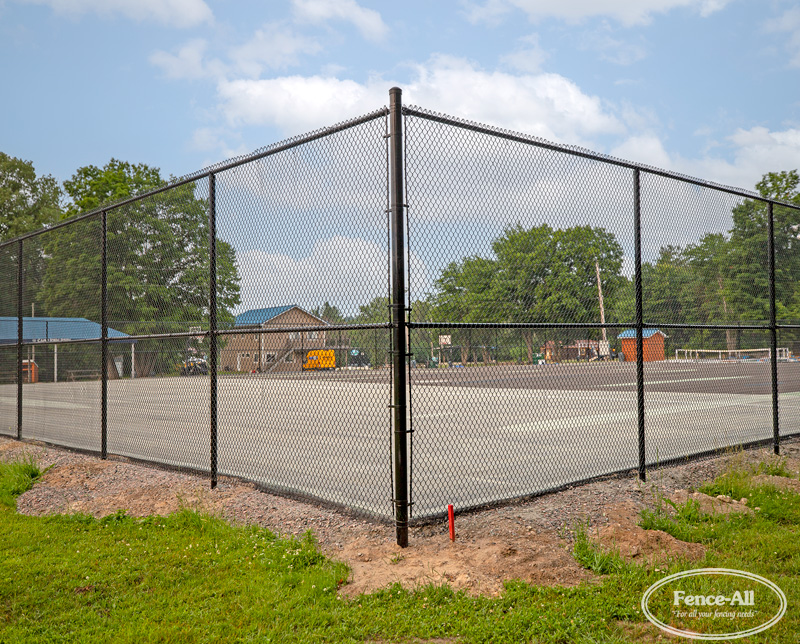
Chain link is an affordable mainstay for residential, commercial, and sporting applications.
Improvements That Made It Popular
Although Barnard pioneered the concept, the fence we recognize today evolved over decades.
In the early 20th century, Frank J. Mafera patented improvements to the manufacturing process. His work made the wire fabric smoother, safer, and easier to install. These changes helped chain link fencing spread across North America for residential, industrial, and recreational use.
By the mid-1900s, chain link fences had become a standard solution for:
How Chain Link Fences Are Made Today
Modern chain link fences are still made using a similar concept to Barnard’s original idea:
- Steel wire is galvanized or coated to prevent rust.
- Machines bend the wire into zig-zag shapes.
- Each wire is interlocked with the next to form the diamond pattern.
- The mesh is rolled into long coils for transportation and installation.
Despite advances in machinery, the basic engineering principle has remained almost unchanged for more than 180 years.
An Everyday Invention With a Textile Past
The chain link fence might seem like a purely industrial invention, but its roots lie in the textile mills of 19th-century England. By adapting cloth-weaving technology to metal wire, Charles Barnard created a product that would eventually surround playgrounds, protect properties, and define boundaries around the world.
Sometimes the most ordinary things in our environment have the most unexpected origins—and the chain link fence is a perfect example.
More Questions about Fences?
Give us a call at (613) 736-1122. We’d love to hear from you!